Monday, April 03, 2006

Battle of the Wafd

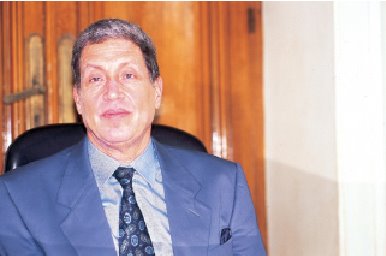
Former head of the Egyptian Wafd Party (Officially the Neo-Wafd, after its reformation in the 1970s) Noman Gomaa, and 14 others) has been placed under arrest and will be imprisoned for a period of four days while the investigation into the events of Saturday the 1st of April. Gomaa, and the 14 others (including Wafd MP Ahmed Naser and his two sons), were formally charged with attempted murder, possession of firearms and munitions without license, arson, thuggery, disturbing the peace, possession of arms, disturbing the peace and the injury and wounding of 27 people.

Noman Gomaa. Former Head of the Neo-Wafd Party.


Apparently, Gomaa thought to return to his former position of party leader.

How ridiculous!

The Egyptian press had pictures of people carrying Molotov grenades, different bullet-casings of spent bullets used in the attack. There were also pictures of the party headquarters after the attack:


I'm reminded of pictures of Palestinian homes after the Israelis have been through town, or the old pictures from my history book which have french houses after the Germans have bombed them to hell.

Gomaa (71) had been removed from leadership of the Wafd party by the party's general assembly but apparently refused to accept the decision. Rumour has it that party opposition claim that Gomaa is merely a government agent and accomplice; ensuring that the semblance of Democracy is upheld while ensuring that the party is ineffectual (I think it will be ineffectual either way, but that's just me).

What's interesting about the whole thing is that its not (and I really have no problem with this) of enough importance to warrant a place on the Home Page of the news websites that I visited to get the pictures you see above.

One last thing: there were rumours that Gomaa's move was carried out with government blessings but that the carnage and destruction that resulted were just too much for the Egyptian authorities not to act. It is a fact though that there were security personnel (Central Security forces - the equivalent of riot police) present during the "attack". Im guessing because of the extreme centralization of the Egyptian bureaucracy, especially when it comes to such situations, they didn't life a finger until other police forces arrived on the scene and Gomaa was arrested and taken from the scene, under police protection, in (get this) an armoured car. Apparently Gomaa forces broke through the Wafd lines but were surrounded, and could not escape without police support.


And that's the way I see it.


Sunday, April 02, 2006

Some Hepatitis C and TB, please. Thank You.

While heading over to meet my extremely significant other tonight, via taxi, an interesting thought came to me; most of my blog posts seem to have been inspired, in some way or another, by conversations with cab drivers. At first, that started an alarm bell buzzing at the back of my mind. You see, there wa this university professor of mine that got all her information from taxi cabs. She said so herself. Naturally, we all thought it was ridiculous (we, as in her students).

Either way, I started a conversation with the driver. It had been raining, the streets leading out of Maadi were relatively crowded; a phenomenon that does not occur without the presence of an accident, a broken-down car or other possible major traffic obstacles. But it was merely the rain. Not the same rain of Last Tuesday, this was actually sporadic rain that never-the-less flooded Maadi more than the previous bout of water.

The conversation with the driver jumped from topic to topic and issue to issue. First was the rain, then the traffic, then the quality of driving, then the quality of the streets, then the government followed by the Prime Minister, the previous Prime Minister and finally... Corruption. Yes, indeed, corruption. The Modern Scourage of Civilizations. Corruption, the root of all evils, especially in a country like this.

The Taxi driver began recounting personal experiences to do with the bureaucracy and how it took him one months to get the new computerized birth certificate from the office of civil records. Every time he'd go to the office, he'd stand in line only to have the power go out, the computer crash or go bust in some way or the employee simply disappearing. I nodded. Such was Egypt, we all knew.

Then it was my turn, so I complained about having to go to the Main Office of Civil Records over in Abbasiyya. Since I was born outside of Egypt, and until the system was computerized (I dare not say fully, I think that is quite improbable - not to mention impossible - in this country), I needed to go there whenever I needed new papers, or official copies of old ones. This Office consisted of many, many floors in a high building. It wasn't easy, as almost anyone who had to go through the endeavour would tell you.

I would have thought that the conversation would end at this point, I would take out a cigarette, smoke it and stay quiet, waiting for the cab driver to intiate a new topic of conversation. Or he might stay quiet himself. Instead, the driver then mentioned the idea of the office boy at the telephone company. Usually an old man, he would go around to people standing in line to pay their bills, take ten pounds to all those that wish to "speed up" the paying of their bill. The money would then be shared with the clerk who would, indeed, help with the completion of the aforementioned transaction. The idea of the office boy followed my description of how smooth these matters occurred when I lived in the U.A.E. We discussed the fact that Abu Dhabi has a much smaller population, that the country as a whole was much richer. We discussed the fact that these clerks and office boys barely get enough money to sustain themselves... not to mention buy food, feed a family, pay rent, food for clothes, books for the children, school fees etc.

We understood all that, me and the cabbie, and agreed that it's a vicious cycle that is quite difficult to break out from. What irked me though were all the things that had nothing to do with the money, or the technology or the population. The things that had to do with the people. I let him know my thoughts. He summarily pointed out that everything has to do with money. To that, I immediately agreed... there was no way I could argue against that.

The man then proceeded to tell me an interesting tale:

"You know how all these Gulf Countries ask for medical tests and Blood Analysis results to grant work permits?" he asked. I didn't, but I nodded my head never-the-less. The Cabbie figured out that I didn't - there was a slight smile and a look with obvious meaning - but he continued with his story, seemingly unaware of this.

"Well, everyday, everyday! in front of the Ministry of Health and their laboratories, at six or seven in the morning, you will find lots people, young men and old, sitting all over the sidewalk."

I commented that this was not an unnatural phenomenon in Egypt. We all know about how people have to line up in front of government buildings, often with the break of light, to be able to put through an application or request or whatever. The man smiled and shook his head slightly. Unexpectedly calm, even though most other Cab drivers' voices would have been raised at this point - becoming one with their story and living the experience through their story-telling - and their arms (or at least one arm - they are driving) would have been flailing, the driver continued his story;

"No, no. You misunderstand. They are brokers." (He actually used the arabic word samasra.)

I raised an eyebrow quizzically and then quickly put to words my thoughts, lest he think the gesture was one of disbelief, rather than surprise (which was what I was feeling). He smiled.

"You see, they wait for those helpless workers who come in the morning, hoping to get their tests done. The test results come out in two months, two months. These people take a bit of money, and the results miraculously come out in two days. What a difference!" The last sentence was said with a short sardonic laugh and a cynical smile followed. He paused for a bit, shook his head, then continued;

"You know what they do? They switch the vials." My eyebrows knotted.
" You know, they take the vials that have tested negative for any disease or virus, and switch them with these vials. They switch the labels, the lab technicians. This way they cannot be blamed. Sample for sample. Vial for vial." I was surprised. Even though one learns to expect the unexpected in Egypt, I was surprised. But, I nodded my head and made the usual derogatory remarks aimed at the government and the so-called brokers. I also asked the guy if that means they speed up that person's test while other tests are left behind.


"No. They just switch them. The Lord knows who has what virus or what disease. They just switch them, ya basha. If you have Hepatitis C, or TB, or Bird Flu or anything else, and you pay those brokers, you'll get a paper saying that you're the perfect man. Someone else gets your disease."

I askecd him how much you pay for the blood analysis thing. He mentioned a number that I don't remember... but it was not some small amount. Keep in mind that the people who visit the Ministry's Labs are usually poor workers that cannot afford to private clinics or centers which would carry out the same tests.

That just about cinched it for me. Egypt. In all its glory.

The ride didnt end there, we discussed how his License-reneweal medical check-up costs 10 L.E. to perform, but 80 to get it in three days; a huge disparity if you think about how much that amount of money means to a Cab driver.

We discussed how the President cannot choose someone who understands all these below-the-table dealings and attempts to reform them without offering some sort of substitute (they'd be assassinated, was our conclusion). Finally, we discussed how the Prime Minister is always the political scape goat. Someone who greatly represents the element of magnesium (isn't this the one that ignites when it comes into contact with air? - I got a C in Chemistry; shines for a bit but burns out real quick.

I paid the man 15 pounds for a 12 pound trip (or 10 pounds if you're my brother).


He helped me with the way I see it.


Wednesday, March 29, 2006

Total... er, partial eclipse of the Sun.

Today, Egypt was one of those countries fortunate enough to experience the Total Solar Eclipse. Sadly, this was in Salloum, way over by the western border of the country, right next to Libya. In Cairo, there was only a partial eclipse.

In the school where I work, as usual, there was a big controversy regarding the eclipse. Here's how it went:

Someone in administration heard that there is a high chance of being blinded if you were to stare at the sun during the eclipse. Now, while I do not know the scientific truth of the matter, I will assume (for the sake of argument) that this is, in fact, true. What happened was that they re-scheduled the break 45 minutes earlier than usual. (With the old timing, break-time closely co-incided with the estimated time when there would be the maximum eclipse for Cairo).

Of course, the point behind this was to make sure that non of the kids stupidly look at the sun disk while the eclipse was "in process". What happened was that during the eclipse, one of the teachers (I'm guessing) allowed his/her kids out (again Im guessing because they asked/begged and annoyed them) to check out the eclipse.

I'm not sure if the kids were meant to return to the classroom promptly, or not.

Since the Head-Mistress (Principal) was not present at that point in time (she had to go to this hospital because her son had been injured playing sports earlier in the day), non of the other administrative staff did anything about the issue. Furthermore, sixth period (eclipse-occuring time) was designated as a free period where the kids could (if they wished) join the "eclipse-prayer". I have never heard about this before, but I will suppose that it exists in Islam or something.

There was no-one assigned to supervise those kids that did not wish to pray or the classes of the teachers that did wish to pray; all occurred haphazardly. This prayer was organized quite efficiently, in record time, if I may add. Of course, no real teaching occurred during the last two periods (which were over 8 minutes longer than usual because of the shortened and re-scheduled break)

My question is this: How on earth could an administrative staff, and a Head Mistress, expect to foster a proper educational environment if the decisions they make are abrupt and carried out with barely any warning. The teachers were more confused than the students. (I actually believe that the students are used to living in this chaotic atmosphere... they seem to thrive in such a climate.)

Whenever a teacher errs, or supposedly errs (the same thing to the administration), there is usually hell to pay. I would not be surprised if public lynching of the teacher became institutionalized policy. It surprises and shocks me that simple organizational steps cannot be set, followed and maintained. The school actually claims that they educate the future leaders of this country. Woe be unto us if this is true!

If I was in charge of this country, or had any say in the matter, the school staff and all administration personnel responsible for such chaos and confusion would be tried for High Treason, found guilty and summarily shot. I'm dead serious. One did not expect that private schools would be more corrupt than public schools, but apparently this is so. One expects governments, and especially the Egyptian government, to do a bad job. Schools who charge their students exorbitant fees for mediocre services, should not.

But that's just the way I see it.

Tuesday, March 28, 2006

The Rain

It rained yesterday. That was quite strange.

I imagine all Cairenes had already assumed the summer was upon us (yes, this early) because the temperature has been increasing steadily for the past two weeks. More and more people had already begun to shed their winter outfits and make ready for spring (that is, if one can call the period between winter and summer - generally lasting no more than a day to a week - spring).

As I took a cab back home from Downtown Cairo (from near the American University in Cairo's Greek Campus), I noticed a couple of good things about the rain; the trees seem greener and the air smelled different, somewhat purer (not pure, of course. I doubt that anything short of divine intervention or a nuclear weapon can rid Cairo of the obscene levels of pollution that it suffers from). But aah! The trees were beautiful.

And that was about it.

Being Egyptian, and living in Egypt, I did not allow any shred of happiness to overcome my sensibilities. As usual, I was proven correct in my decision. I had to wait for an empty cab for a period which exceeded thirty minutes. As a general rule, this is a bit much. This is because most Egyptians are completely unfamiliar with rain. It's also because government officials, or those in the Ministry of Transportation, clearly have no idea on how to plan and construct decent roads.

Let me explain. (Thought I warn you, this may take a bit and could be detrimental to your psychological health.. as an Egyptian. To all non-Egyptians, well... behold some of the miniscule reasons why I personally believe Egypt, as a country, should be declared one of the wonders of the modern world.)

I'll start with the roads. Most Cairenes with a decent memory span of one year (you can't expect more from Egyptians) or... more(!!!) understand perfectly well that rain is an urban disaster in Egypt; the roads flood, the metro (subway, tube, whatever) breaks down, public transportation in the form of buses and so on also break-down, walls leak, sewege and drainage pipes overflow... the whole works. In all honesty, this makes no sense at all.

You see, most Egyptian roads, in my humble opinion, should be labeled as hazardous. Apparently, in an attempt to keep Egyptians drivers and pedestrians on their toes (always on the lookout for possible hazards), no two Egyptian roads look alike, feel alike or are even designed alike. Hell, the same road in Egypt takes on forms that are so different that were you to blindfold a passenger in any four-wheeled vehicle (preferably a non-Egyptians. The Egyptians would be fooled for maybe... 3 seconds, then they'd identify the exact address - including the closest building number), they would probably believe that they are traversing urban, rocky, desert, tundra and savannah terrain all in one go.

You have streets which are V-shaped, then you have those that take on a wave form, then you have streets that go like this: / or like this \. Or a combination of both - /\/\/\/\.

You have streets with pot-holes, you have streets with ditches, you have streets with sidewalks, without sidewalks, with asphalt, without asphalt, with and without asphalt (Thirty-One flavors?! Humph! The Egyptian government has put Baskin Robbins to shame!) You have streets which wiggle you, make you slide, spin, rotate, vibrate, elevate, depress, compress and dissect you. (The combination is always a secret... and subject to change. You'll always be caught with your pants down.)

We don't have regular streets (usually consisting of a long, black smooth surface which is slightly curved upwards in the middle). WHY WOULD WE?! Why on earth would any sane, logical person want to have a road where the water automatically moves to the sides and where a gutter and efficient drainage system awaits to whisk it away through a myriad of well-designed, placed and built pipes?! I know why! Why that would be completely and utterly boring. This way, every time it rains, all car-drivers can imagine they're boat captains (Ahoy there Cab Driver!) and navigate around the city. Because of the state of some Cairo streets, the previous statement isn't really an exaggeration.

As it stands, when it rains, the normally insane Egyptian drivers split into factions;

King of the Jungle Faction: The group of people that will inform you that rain or shine, nothing stands in the way of their vehicle. They will continue driving along at speeds in excess of 100 km/h (in 60 km/h zones). As a special treat, and to illustrate their point more practically, they might even consider bumping up their normal vehicular speeds a good 20-40 km/h. To prove a point you see.

Head in the Ground Faction: My personal favourites. This group of people will slowly and surely inform you that to move beyond 1 km/h in the rain is a sure way to ultimately damage your vehicle. Thus, they plod along at 1km/h, effectively causing 5 km traffic jams. (What really bothers me is that they refuse to go home and park the car... As far as I can deduce, their dogma stipulates that they continue driving around the way they do, in order to spread awareness of their beliefs.)

Heads will Roll Faction: Most drivers fall into this category when it rains. This group of drivers will drive along at a moderate speed, slow down when it comes to newly created middle-of-the-road oceans, seas or lakes. A little faster when the road clears up. But, they are extremely pissed off because of the behaviors of the Head in the Ground Faction and the King of the Jungle Faction.


Rain in Cairo will, apparently, forever change the way you view the environment. Rain in Cairo will turn the staunchest Green Peace activist into a hardcore mother-nature vandal. Yes indeed!


Ain't I lucky that I don't have a driver's license yet?


And that's the way I see it.


Monday, March 27, 2006

My! How things can change.

Sadly, this is another MUN post. Hopefully, it will be one of the last ones (at least for quite a long time to come).

I got involved in a discussion with a friend who was part of the CIMUN (Cairo International Model United Nations) before. Naturally, this was after they had read my previous post in which I was not very pleasant towards CIMUN.

Basically, after I discussed the details of the matter with them, giving them names, occurences and dates and after the whole thing went back and forth for a while, I was quite satisfied with the conclusion that we had reached (Don't expect a biblical revelation); its possible that I was a bit harsh criticizing the organization. Knowing that I only criticize because I believe in the essence of the MUN, hence the number of times that I joined the Organization either as a Delegate, Secretariat or Organizing Committee member, I should maybe direct my criticisms at the people I have a problem with and not the whole organization.

In fact, I obviously would not attack the organization unless I was criticizing the reasons for which it is created or the mission it attempts to carry out. What happened was that I (and I do this often) mis-phrased what I wanted to say. This is probably because there was a large number of people that I wanted to criticize, so I just went on and blamed the whole organization.

Also, and I forgot to mention this before, the degree of subjectivism was obviously high. I will not defend that though. They were my personal views and thus they are nothing if not subjective. Still, and I won't get into details, I know the feelings I harbored were obviously too intense.

Last of all (thank you for hanging in there!), I should mention that I still don't agree with lots of self-congratulating that occurs in MUN and the amount of needless back-scratching that occurs. I also find it strange that some people manage to judge how others perform without any possible benchmark, basis or knowledge upon which to base their judgement.

Have some shame and stop telling people that they suck or kick ass simply because they you don't/do like them. Have you learnt nothing from all those courses that you are taking/took to get your degree?!

And that's just the way I see it.

Tuesday, March 21, 2006

A Spin on the Strange Turn of Events

In an egomaniacal attempt to hold onto my position of ‘Devil’s Advocate’ in all things posted on this blog, I will try and put a spin on Faisal’s blog on Ibrahim Nafea.

Consider this: We live in a country where the bureaucracy is the be all and end all of…well, all, people tend to forget one very simple variable that cannot be ignored: human nature. Allow me to explain.

A wise man once said: “Power corrupts. Absolute power corrupts absolutely.” It is a natural progression (please permit me this generalization, and a few more to come) of events for a person who had nothing to thank his lucky stars when he/she gets a break. In most cases, he/she will take full advantage they will now find themselves in.

Now you will be thinking “That’s not an excuse!!” And you’re right, it isn’t…I’ll get back to this later on. Let’s examine another side of the equation. The system, as it exists (as it existed?!?!) does nothing to combat this kind of corruption. Worse, it does a great deal to encourage it. The ruling clique is very likely to be highly suspicious of someone who doesn’t ‘join the club’ so to speak; that might indicate that the person in question has… morals (aaaarrrrrgghhhh!!). A big no-no if you happen to hold some position in the government. See, it’s all well and good if the person just simply doesn’t want to take anything, more for me (this ‘them’ thinking); but what happens if, heaven forbid, that moral person suddenly decided that everyone else should be moral too?

And so, if you follow this line of argument, the only people who are capable to fighting the corrupt-powerful are those that are as, or more powerful, than them.

Now let’s get to the crux of the matter: For those that comment on the corrupt or lament the powerful for their moral ambiguity, would you be any better if placed in the same position, provided with the same opportunities and placed under the same pressures?

Think about it for a while; we’ll discuss this again soon.

A Strange Turn of Events

I discovered yesterday that a co-worker, an Economics Teacher, is the Daughter in law of Ibrahim Nafae. This is significant because I had just published a post on my Blog, yesterday, discussing corruption and the fact that this teacher's father-in-law was being investigated for suspicion of wide-scale corruption while heading Egypt, and the Arab World's, most distributed Arabic Newspaper.

The situation becomes very strange when you are actually acquainted with someone whose family will be directly affected because of such an issue. It's not that I feel any sympathy for Nafae (or, I should say, I will not feel any sympathy for him if he is found guilty and punished), it's just somewhat awkward listening to her (she seemed to be taking it well - and this isn't an air-headed or callous woman) discussing how she explained to her children (16 and 20) what the whole thing was about and that they should come to expect that their house might be searched and their things meticulously picked through by investigators.

My father, a media man himself, explained to me his own experiences with Nafae. Apparently, Nafae's wife was a colleague of his way back when he worked with the Egyptian Radio and Television and they were not doing financially well. This was until Jihan El Sadat, Deceased President Sadat's wife, chose him to be in charge of her monetary affairs. A front man, so to speak. My father tells me that when Nafae was chosen to be Editor-in-Chief, the media world was shocked that this man (apparently an insignificant at that point in time) was brought in to head Egypt's most presitigious newspaper.

He then went on to tell me how people in Al Ahram Press, and in particular a friend of his who holds a managerial position there, informed him that Nafae and his sons (one of whom is married to my co-worker) went on to monopolize the newspaper's source of paper, ink, glue, machine spare-parts and other matters. This is, of course, independant of their use of their connections to obtain large pieces of land at cheap prices and then selling them again at outrageous prices (but I won't consider this as being of a corrupt nature since I do not have relevant Real Estate information about land prices etc).

The situation is strange because on one side, I like my co-worker. She's an interesting, fun person. It's easy to make conversation with me, and she understands what I'm talking about even though there is a large difference in age between us and she's an economist (hehe). But, realizing that the money that her husband obtained, money that she herself used to buy her clothes, cars, travel etc was money obtained through stealing and corruption is not something that I can accept easily.

I will not judge her or sever any acquaintance-ship between us at this point in time (or, I should say, I will very much attempt not to do so). I'm just confused about how I should react.


And that's the way I see it...